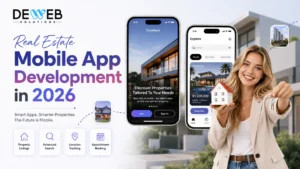

eCommerce mobile app development means building a shopping app that lets customers browse, buy, and track orders straight from their phone. A basic app costs $35,000–$90,000 and takes 3–5 months. A full-featured app with AI search, AR try-ons, and multi-region support costs $180,000–$400,000+ and takes 7–12 months.
- ✓eCommerce apps split into distinct types, B2C, B2B, C2C, C2B, social commerce, and subscription, and each one needs a genuinely different feature set, not just a different color scheme.
- ✓Apple's ongoing legal fight with Epic Games means US apps are currently paying zero commission on qualifying external payment links, but Apple has just proposed a new 5%–15% fee, so this window may not stay open much longer.
- ✓Mobile shoppers abandon their carts at a meaningfully higher rate than desktop shoppers, and the gap comes down to app architecture decisions, not just checkout copy.
- ✓Ongoing costs, payment processing, tax calculation APIs, and shipping label APIs, routinely add 3%–8% of revenue that most upfront cost estimates never mention.
- ✓A basic eCommerce app costs $35,000–$90,000 and takes 3–5 months, while a full-featured platform with AI and multi-region support costs $180,000–$400,000+ and takes 7–12 months.
- eCommerce apps aren't one product type. B2C, B2B, C2C, C2B, social commerce, and subscription apps each need different core features, and picking the wrong template usually shows up as budget overruns six months in.
- Apple's commission structure for external payment links is actively being litigated right now, and the rate you'll pay in 2027 may be different from what you pay today, so build your checkout with that flexibility in mind.
- Mobile-specific cart abandonment consistently runs well above desktop, driven by small-screen friction, not a lack of buyer intent, and that gap is closable through concrete architecture choices covered in this guide.
- A basic eCommerce app MVP costs $35,000–$90,000 and takes 3–5 months; a full-featured platform with AI search, AR, and multi-region support costs $180,000–$400,000+ and takes 7–12 months.
- Ongoing costs, payment processing, tax APIs, shipping APIs, and fraud tooling, typically add 3%–8% of revenue every month that most upfront quotes never mention.
- Post-launch, budget 15%–20% of your build cost annually for maintenance, and expect to add real features based on what your first cohort of shoppers actually does inside the app.
- What Is eCommerce Mobile App Development and Why Does It Matter in 2026?
- How Big Is the Global eCommerce App Market?
- What Are the Different Types of eCommerce Apps?
- What Are the Real Benefits of eCommerce App Development?
- Why Is Apple's Ongoing Commission Fight a 2026 Decision You Can't Ignore?
- What Features Does an eCommerce App Need in 2026?
- How Is an eCommerce App Built Step by Step?
- What Is the Best Tech Stack for eCommerce App Development?
- How Much Does eCommerce App Development Cost in 2026?
- Why Do Mobile Shoppers Abandon Carts More Than Desktop Shoppers?
- What Monetization Models Work Best for eCommerce Apps in 2026?
- 7 eCommerce App Development Mistakes That Kill Conversions
- Why Choose DeWeb Solutions for Your eCommerce App Development?
- Conclusion
- Frequently Asked Questions
eCommerce mobile app development is the process of building a shopping app that lets customers browse products, complete a purchase, and track their order, all without opening a browser. I've worked through ecommerce application development projects at every scale, from a single-founder brand launching their first app to retailers juggling multiple warehouses and payment regions, and the pattern repeats every time. The businesses that treat their app as a real product, with its own architecture decisions and its own compliance questions, are the ones that see the app actually pay for itself. The businesses that treat it as "the website, but smaller" are the ones stuck fixing checkout six months after launch.
This guide walks through the real 2026 picture of eCommerce mobile app development: the types of apps worth building, what they actually cost, the live legal fight over app store fees that most guides haven't caught up to yet, and the specific reason mobile shoppers abandon carts more than anyone else.
What Is eCommerce Mobile App Development and Why Does It Matter in 2026?
eCommerce mobile app development is the work of building a dedicated shopping app, separate from your website, that gives customers a faster, more personal way to browse and buy on their phone. It matters in 2026 because mobile now drives the majority of online shopping traffic, and a website that was never designed for a five-inch screen is a genuinely worse experience than a purpose-built app.
Three shifts make this the right moment to build one, if you haven't already.
Shopping has become a phone-first habit, not a desktop errand. People check prices while standing in a store, reorder something from their couch, and browse a wishlist on their commute. A dedicated app meets that behavior directly, with push notifications, saved payment methods, and a home screen icon a website simply can't replicate.
The gap between a good and a mediocre checkout is now measured in real revenue, not just user experience scores. Every extra step, every slow load, and every unclear shipping cost pushes a mobile shopper closer to abandoning their cart, and I'll walk through exactly how much that costs later in this guide.
The rules governing how ecommerce apps can charge for digital add-ons just changed, and they're still changing. If any part of your app monetizes through subscriptions, memberships, or premium features, a live legal fight between Apple and Epic Games directly affects your margin in 2026, in a way almost no other guide on this topic mentions. I'll explain exactly what changed, and what's still unresolved, further down.
eCommerce App Development Market: A Quick Insight

The eCommerce app market specifically, not just online retail broadly, was worth roughly $3.48 trillion in 2026 and is projected to reach $5.07 trillion by 2031, growing at a 7.82% annual rate. That sits inside a much bigger picture: global retail eCommerce sales are projected to cross $7.41 trillion in 2026, and the wider digital commerce economy, which also counts B2B trade conducted online, is forecast to reach $155.98 trillion by 2033. Whichever number you look at, the direction is the same, more of every kind of commerce is moving through an app, not a browser tab.
Beyond the top-line size, a handful of figures matter more to anyone actually planning to build an app than the total market number does.
Mobile Commerce Is Growing Faster Than eCommerce Overall
Mobile commerce sales are projected to reach $2.74 trillion in 2026, a 9.16% jump from 2025, consistently outpacing overall eCommerce growth rates year over year. That gap between total eCommerce growth and mobile-specific growth is exactly what a dedicated app is built to capture.
Android Wins on Installs, iOS Wins on Revenue
Android held about 72.67% of eCommerce app installs in 2025, driven largely by affordable devices across Asia and Africa, but iOS users, despite representing only around 19% of downloads, accounted for roughly 45% of total transaction value. If your app strategy only tracks install counts, you're missing where the actual spending happens.
The retention number every founder should see before writing a line of code: Standalone shopping apps lose about 70% of new installs within the first 30 days. Getting someone to download your app is the easy part. The real work, and the real return, comes from the onboarding, personalization, and loyalty features covered later in this guide that keep people past week one.
Shoppers Will Install an App for the Right Incentive
84% of shoppers say they'd install and shop through a brand's app if it gave them access to better pricing or exclusive sales, and 99% of online shoppers check reviews before buying anything, on any device. Both numbers point to the same lesson: an app earns a spot on someone's phone by offering something the website doesn't, not by duplicating it.
Fraud and Trust Are Real Budget Line Items, Not Edge Cases
Global eCommerce fraud losses hit an estimated $48 billion in 2023, and cumulative losses to online payment fraud between 2023 and 2027 are projected to exceed $343 billion. Building fraud detection and a secure checkout into your app from day one isn't optional risk management, it's a cost category every serious eCommerce app budget needs to plan for from the start.
That growth shows up directly in how people search for products today, too. Buyers aren't just occasionally glancing at their phones during a shopping session anymore, for most people, the phone has become the main tool they use from browsing to checkout.
That scale is exactly why the eCommerce app space has gotten more competitive, not less. A generic shopping app with a stock template and a plain product grid doesn't stand out anymore. Buyers now expect saved preferences, real-time order tracking, and a checkout that remembers who they are, and the brands that deliver that are the ones capturing repeat purchases instead of one-off sales.
What Are the Different Types of eCommerce Apps?
eCommerce apps fall into six distinct types, and choosing the wrong one for your business model is the fastest way to end up with features you don't need and a missing feature you do. Ecommerce application development starts with this decision, not with a wireframe.
| Type | Who It's For | What Makes It Different | Real-World Examples |
|---|---|---|---|
| B2C | Businesses selling directly to individual shoppers | Focuses on fast browsing, personalization, and one-tap checkout | Amazon, Sephora |
| B2B | Businesses selling to other businesses | Needs bulk ordering, custom pricing tiers, and invoicing, not impulse-buy features | Alibaba, Grainger |
| C2C | Individuals selling to other individuals | Built around listings, messaging between buyer and seller, and trust signals like ratings | eBay, Etsy |
| C2B | Individuals offering skills or services to businesses | Centers on profiles, portfolios, and proposal or bidding workflows instead of a product catalog | Upwork, Shutterstock |
| Social Commerce | Brands selling through social feeds and creator content | Needs shoppable posts, creator tagging, and a checkout that works without leaving the feed | Instagram Shopping, TikTok Shop |
| Subscription | Brands selling recurring boxes or memberships | Built around billing cycles, pause/skip controls, and churn-reduction flows | Birchbox, Blue Apron |
The type classification mistake that inflates budgets the most: A B2C app and a B2B app can share the same product catalog on paper, but a B2B buyer needs role-based purchasing approval, net-30 invoicing, and bulk pricing tiers that a B2C impulse-buy flow was never designed to support. Businesses that start building on a B2C template and try to bolt on B2B logic later usually end up rebuilding the checkout and account system from scratch. Decide your primary type before a single screen gets designed.
What Are the Real Benefits of eCommerce App Development?

eCommerce app development pays off through higher conversion rates, stronger repeat-purchase behavior, and direct access to customers that a website, or a listing on someone else's marketplace, simply can't offer. These aren't abstract claims, either, each benefit below is backed by real, current data on what actually changes when a business moves from "website only" to "website plus app."
Saved addresses, saved payment methods, and a browsing history the app remembers turn a five-minute checkout into a 30-second one. Simplifying checkout to three steps instead of the industry-average 5.08 steps is one of the single biggest levers for cutting cart abandonment.
Push notifications reach a customer who already trusts your brand enough to install your app, without paying an ad platform or a marketplace algorithm to get in front of them again. That direct channel matters more once you consider that standalone apps lose about 70% of new installs within 30 days, every notification is a chance to be part of the 30% that stays.
A dedicated app removes browser chrome, autofill quirks, and slow mobile page loads, all of which quietly tax conversion on a responsive website that was designed for desktop first. 84% of shoppers say they'd install and shop through a brand's app specifically for better pricing or exclusive access, a clear incentive most websites can't replicate.
App analytics show exactly how a customer browses, what they abandon, and what brings them back, data a third-party marketplace listing will never hand over to you. That first-party data becomes more valuable every year as privacy rules limit how much brands can learn from ad platforms alone.
Points, tiers, and rewards live right where the purchase happens, instead of a separate card or email a customer forgets about between visits. It's no surprise that about a third of businesses without a loyalty program today plan to launch one within the next couple of years.
99% of online shoppers check reviews before buying, and nearly half say they trust customer reviews as much as a recommendation from a friend. Building reviews and ratings directly into the app, rather than sending shoppers off to search for them elsewhere, keeps that trust-building moment inside your own product.
Free shipping is the single biggest motivator for online shopping at 50.6%, followed by coupons and discounts at 39.3%, and offering a Buy Now, Pay Later option at checkout gives shoppers who'd otherwise hesitate on a larger purchase a real reason to complete it, BNPL users show meaningfully higher lifetime value than one-time buyers.
A well-built app signals a level of investment and permanence that a plain website doesn't, and that perception carries real weight with repeat buyers deciding who to trust.
A properly architected app handles growing catalog size, order volume, and seasonal traffic spikes without the performance cliff a bolted-together website often hits first, exactly the kind of resilience that matters once mobile commerce keeps growing faster than eCommerce as a whole.
Get the Right Architecture Before You Spend a Dollar on Development
Our team at DeWeb Solutions builds eCommerce apps for California brands that need real conversion, not just a pretty product grid. As experienced mobile app developers California businesses trust, we scope your app type, payment strategy, and integrations up front, so your budget reflects the system you actually need.
Why Is Apple's Ongoing Commission Fight a 2026 Decision You Can't Ignore?
If any part of your eCommerce app charges for subscriptions, memberships, or premium digital features, Apple's still-unresolved legal fight with Epic Games directly affects your margins right now, and the rules have shifted multiple times in the past eighteen months. This is a detail I have not seen a single guide mention, even though it changes real numbers on a spreadsheet.
First, the part that hasn't changed: apps selling physical products have generally never been required to route payment through Apple's in-app purchase system. If you're building a straightforward B2C or B2B app selling physical goods, this fight mostly doesn't touch your core checkout. Where it matters is the growing share of eCommerce apps monetizing through subscriptions, paid memberships, or premium features, exactly the kind of model more brands are adding in 2026 to build recurring revenue.
Here's the timeline that actually matters for your planning. In April 2025, a federal court found Apple in contempt for charging a 27% fee on external payment links and barred it from collecting any commission at all on qualifying off-app purchases. In December 2025, the Ninth Circuit upheld that contempt finding but said Apple could eventually charge a commission tied to the real cost of coordinating those external links, not a blanket ban. As of this guide's publication, Apple has proposed a new tiered commission of up to 15% for standard apps, 10% for subscription renewals, and 5% for its Small Business Program, and that proposal is still working through the lower court. Separately, the Supreme Court agreed in June 2026 to hear Apple's broader appeal, with arguments expected in its October 2026 term.
The real tradeoff most guides miss: Right now, in the window before a new commission rate is finalized, US apps can route qualifying subscription or membership purchases to an external checkout with effectively no Apple commission. That's a meaningful margin advantage if your app has any recurring-revenue component. But building your entire monetization strategy around a $0 commission rate that's actively being litigated is a mistake. Build your subscription and payment logic so it can flex between in-app purchase and an external checkout link without a rebuild, because the rate you plan around today may not be the rate you're paying in a year.
What Features Does an eCommerce App Need in 2026?

A competitive eCommerce app in 2026 needs two distinct sets of features, one for the shopper and one for whoever runs the business behind the scenes, and treating the admin side as an afterthought is one of the most common reasons ecommerce mobile app development projects go over budget.
Shopper-Side Features
- User registration — a quick sign-up with email or social login that saves a shopper's details, order history, and preferences for faster future purchases.
- Searchable, filterable product catalog — fast, typo-tolerant search with filters that actually narrow results instead of just sorting them.
- Rich product pages — high-quality images, variant selection, stock status, and honest delivery date estimates.
- Persistent shopping cart — a cart that survives an app close, with real-time price and shipping cost updates.
- Wishlist — a simple way for shoppers to save items for later, which also gives you valuable signal on purchase intent for future marketing.
- Guest checkout with multiple payment options — cards, digital wallets, and at least one buy-now-pay-later option, without forcing account creation.
- Order tracking and returns — real-time status updates and a self-serve return flow that matches your actual policy.
- Reviews and ratings — genuine social proof that helps a buyer decide without leaving the app to search elsewhere.
- Loyalty and referral tools — points, tiers, or credit that gives a repeat buyer a reason to open the app instead of searching a competitor.
- Push notifications with real preferences — order updates and offers a user actually opted into, not a firehose that gets the app deleted.
Admin-Side Features
- Dashboard — a central hub showing sales performance, inventory levels, and customer activity at a glance, without digging through separate reports.
- Product and inventory management — real-time stock sync across every sales channel, not just the app.
- Order management — a single view to process, fulfill, and handle returns without switching between systems.
- Customer management — purchase history, support tickets, and segmentation in one place.
- Pricing and promotion controls — discounts, coupons, and dynamic pricing rules the marketing team can manage without a developer.
- Analytics and reporting — conversion funnels, average order value, and cohort retention, not just total sales.
- Fraud and payment monitoring — visibility into failed payments, chargebacks, and flagged transactions before they become a pattern.
Advanced Features Worth Adding in 2026
Beyond the baseline shopper and admin tools, a handful of features are moving from "nice to have" to genuinely expected in 2026, and each one below is backed by real performance data, not just trend-chasing.
- AI-powered personalized recommendations — recommendation engines with strong accuracy are raising average order values by roughly 12%–15%, and dynamic bundling has pushed cart sizes up by 18% for merchants who've adopted it.
- Augmented reality try-on and visualization — AR-enabled listings see click-through rates over twice as high as static images, and 40% of shoppers say they'd pay more for a product they could preview in AR first.
- Buy Now, Pay Later at checkout — BNPL transactions in the US topped $133 billion in 2024 and are projected to reach $206 billion by 2029, and BNPL users consistently show higher lifetime value than one-time buyers.
- Live shopping and shoppable video — 40% of US shoppers have already made a purchase through live commerce, and short-video shopping platforms have compressed the path from discovery to checkout to under 90 seconds.
- Social commerce integration — one-tap checkout linked directly from social platforms removes the redirect friction that used to cause a meaningful share of social-referred traffic to abandon before ever reaching your app.
- Predictive sizing and fit tools — retailers using predictive sizing have seen return rates fall by as much as 23%, which protects margin as much as it improves the customer experience.
- Buy online, pick up in store (BOPIS) — a genuine omnichannel feature for any brand with physical locations, giving shoppers the immediacy of in-store pickup with the convenience of app-based ordering.
- Sustainability and ESG signals — brands that back sustainability claims with visible, verifiable data see meaningfully higher repeat-purchase rates than brands that don't, so a simple, honest sourcing or shipping-impact indicator on product pages carries real weight with today's shoppers.
This two-sided structure, one experience for the buyer and one operational layer behind it, is a pattern that shows up in almost every serious commerce or marketplace app, not just retail. We covered the same lesson in transportation app development, where scoping only the passenger-facing app was consistently the most expensive planning mistake. eCommerce apps fail the same way for the same reason: the shopper app is the one everyone pictures first, but the admin tools are what actually keep the business running once real orders start coming in.
How Is an eCommerce App Built Step by Step?

Building an eCommerce app follows a structured eight-phase process, and rushing the early phases to get to visible progress faster is the most common reason projects end up over budget or delayed near launch.
Phase 1: Market Research and Planning
Every solid eCommerce app starts with a clear picture of the audience, the competitors, and the specific app type from the table above. This phase also decides your payment strategy and which regions or currencies you'll support at launch, since retrofitting multi-currency support later is far more expensive than planning for it now. Expect this to take two to three weeks.
Phase 2: Defining Features and Scope
With research in hand, the team locks down which features ship in the first release versus later. A focused MVP, a real catalog, cart, checkout, and order tracking, beats a bloated first version every time, because it gets real purchase data in front of you faster. This typically runs alongside the tail end of Phase 1.
Phase 3: UI/UX Design
Designers build the actual screens: browsing, product pages, cart, and checkout, all optimized to reduce the number of taps between "I want this" and "I bought this." Good ecommerce app design isn't decoration, it's conversion work, and it typically takes four to six weeks.
Phase 4: Backend Development
This is the largest phase and the part shoppers never see directly. It covers the product catalog engine, order processing, inventory sync, and the payment, tax, and shipping integrations that make checkout actually work. Because so much of an eCommerce app's reliability depends on this layer, it usually takes up close to 40% of total development time, roughly ten to fourteen weeks on a mid-sized build.
Phase 5: Frontend Development
The buyer-facing app and the admin dashboard get built in parallel, both connecting to the same backend so nothing gets built twice. This phase typically runs alongside backend work and wraps up over ten to fourteen weeks.
Phase 6: Smart Features and Integrations
AI-powered recommendations, AR previews, personalized search, and third-party integrations like CRM or marketing tools get layered on once the core purchase flow is solid. This usually takes four to six weeks.
Phase 7: Testing and Compliance Review
Payment flows, tax calculation, PCI-DSS scope, and app store guidelines all need a real review pass before launch, not a quick glance the week before submission. Budget three to four weeks here, especially for payment and security testing.
Phase 8: Launch and Ongoing Support
Most teams do well to launch in a single market first, confirm checkout and fulfillment hold up under real orders, then expand. After launch, expect regular updates driven by real cart-abandonment data and customer feedback, not a fixed roadmap written before a single sale happened.
What Is the Best Tech Stack for eCommerce Application Development?
The best tech stack for an eCommerce app depends on your catalog size, transaction volume, and integration needs, and for most retail apps, cross-platform frameworks now deliver performance close enough to native that the cost savings are worth it.
| Layer | Recommended | Alternative | Notes |
|---|---|---|---|
| Mobile App (iOS + Android) | Flutter or React Native | Native Swift/Kotlin | A shopping app doesn't need the constant background processing that pushes some industries toward native, so cross-platform is usually the smarter budget call. |
| Backend | Node.js or Django | Laravel, Spring Boot | Node.js handles high-concurrency traffic spikes, like flash sales, particularly well. |
| Database | PostgreSQL | MongoDB, MySQL | PostgreSQL handles complex order and inventory relationships more reliably at scale. |
| Payment Gateway | Stripe | Braintree, Adyen, PayPal | Choose one with strong tokenization support to reduce your PCI-DSS compliance scope. |
| Tax Calculation | Avalara | TaxJar | Essential once you sell across more than one state or country. |
| Shipping | EasyPost or Shippo | Carrier-direct APIs | Aggregators save real engineering time versus integrating each carrier separately. |
| Cloud Hosting | AWS | Google Cloud, Azure | AWS has the widest range of existing ecommerce tooling and auto-scaling options for peak traffic. |
| Analytics | Firebase / GA4 | Mixpanel, Amplitude | Pair with a proper event tracking plan from day one, not added after launch. |
The one place worth spending on native performance specifically is AR try-on features, since smooth camera and rendering performance genuinely benefits from native APIs. Everything else in a typical shopping app performs well on a cross-platform build.
Build an eCommerce App That Converts, Not Just Displays Products
As a trusted mobile app development company in California, DeWeb Solutions builds eCommerce apps with the payment integrations, tax and shipping logic, and checkout flow that turn browsers into buyers. Our team has delivered mobile products for businesses throughout Los Angeles, San Diego, San Jose, and San Francisco, and we bring that same hands-on experience to every eCommerce build.
How Much Does eCommerce App Development Cost in 2026?
eCommerce app development costs between roughly $35,000 for a simple starter app and $400,000 or more for a full platform with AI, AR, and multi-region support. Nearly every quote below $35,000 is missing real payment, tax, or shipping integration.
| What You're Building | What's Included | Cost Range | Timeline |
|---|---|---|---|
| Basic Starter App | Catalog, cart, checkout with one payment gateway, order tracking | $35,000–$90,000 | 3–5 months |
| Mid-Level App | Above plus loyalty, reviews, push notifications, admin dashboard | $90,000–$180,000 | 5–7 months |
| Full-Featured Platform | Above plus AI recommendations, AR try-on, multi-currency, tax and shipping automation | $180,000–$400,000 | 7–12 months |
| Enterprise/Omnichannel Platform | Multiple regions, ERP/CRM integration, custom fraud tooling, performance SLAs for peak events | $400,000+ | 12–18 months |
The Ongoing Costs Most Quotes Leave Out
Most cost estimates only price the build. The costs below keep running every month after launch, and they routinely add up to 3%–8% of your revenue, not a flat dollar figure you can budget once.
- Payment processing: typically 2.6%–3.5% plus $0.30 per transaction, charged on every single sale.
- Tax calculation API: $50–$500+ a month depending on transaction volume, essential once you sell in more than one state or country.
- Shipping label and rate API: $0.05–$0.20 per label plus a monthly platform fee.
- Fraud detection and 3D Secure tooling: $0.05–$0.10 per transaction, or a flat monthly SaaS fee at scale.
- App store commission on digital add-ons: currently near $0 on qualifying external links for US subscription and membership purchases, but this is actively being litigated and could shift to a new rate within the year.
- Cloud hosting: $200–$2,000+ a month, scaling with traffic and catalog size.
- Annual maintenance: 15%–20% of the original build cost, covering security patches, OS updates, and third-party API changes.
The cost insight most guides don't share: These ongoing costs can quietly turn a $100,000 "development only" quote into a business that's paying $8,000–$15,000 a month before a single dollar of marketing spend. Before signing with any development partner, ask for a full cost-of-ownership estimate that includes payment processing, tax, shipping, and hosting, not just development hours. This is the gap that catches founders off guard most often.
Why Do Mobile Shoppers Abandon Carts More Than Desktop Shoppers?
Mobile shoppers abandon their carts at a meaningfully higher rate than desktop shoppers, and the gap comes down to concrete friction points in app and checkout design, not a lack of buying intent. The global average cart abandonment rate sits at 70.22%, and mobile consistently runs well above that baseline while desktop runs below it.
Most guides mention cart abandonment as a single bullet point, "simplify your checkout," without connecting it to actual app-building decisions. Here's what the gap really comes down to:
- Unexpected costs at checkout. Shipping fees, taxes, and surcharges that only appear on the final screen are consistently the top reason shoppers abandon a cart, on any device. Show a realistic total earlier in the flow, not just at the last step.
- Too many form fields on a small screen. A checkout built for desktop and simply shrunk down forces a thumb to do work a mouse never had to. Auto-fill, saved addresses, and digital wallets remove most of this friction.
- Forced account creation. Requiring a login before checkout is one of the most reliable ways to lose a mobile shopper who was ready to buy. Guest checkout should always be the default path.
- Slow load times. A checkout page that takes more than a couple of seconds to load on mobile data loses shoppers who would have completed the purchase on a faster connection.
The contrarian point worth remembering: Not every abandoned cart is a lost sale. A meaningful share of mobile cart activity is genuine window-shopping, someone comparing prices or saving an item for later, not a broken checkout. The goal isn't chasing abandonment down to zero, it's removing the friction you actually control, unexpected costs, forced accounts, and slow load times, while accepting that some abandonment is simply how people browse on a phone.
What Monetization Models Work Best for eCommerce Apps in 2026?

The most resilient eCommerce apps in 2026 combine more than one revenue stream instead of relying on product sales alone, which builds stability when buying patterns shift with the season or the economy.
- Direct product sales: the core model for most apps, keeping full control over pricing, inventory, and branding.
- Subscription plans: memberships offering free shipping, early access, or exclusive pricing in exchange for predictable recurring revenue.
- Marketplace commission: a percentage on every transaction if you're running a multi-seller platform, growing in step with your seller base.
- Freemium and premium add-ons: free core shopping features with paid extras like priority shipping or ad-free browsing.
- In-app advertising and brand partnerships: sponsored product placements that generate revenue without disrupting the shopping experience.
- Affiliate and referral programs: commission earned by promoting complementary products or driving new customer sign-ups.
The right mix depends on your app type from earlier in this guide. A B2C app usually leans on direct sales plus a loyalty-driven subscription tier, while a C2C or marketplace app depends more heavily on commission. Whichever models you choose, remember the compensation logic tied to any subscription or membership component runs directly into the still-unresolved Apple commission question covered above, so keep that payment flow flexible.
7 eCommerce App Development Mistakes That Kill Conversions
These seven mistakes explain most of the eCommerce app failures I've reviewed, not theoretical risks, but patterns that repeat across real projects.
- Treating the admin panel as an afterthought. An app with no real inventory or order management tools means your team is stuck managing stock in a spreadsheet the moment order volume grows past a handful a day.
- Forcing account creation before checkout. This single decision reliably costs more completed purchases than almost any other checkout friction point, especially on mobile.
- Hiding shipping costs until the last screen. Surprise costs at the final step are the single biggest driver of cart abandonment, and it's entirely within your control to fix.
- Ignoring tax and shipping integration until launch week. Retrofitting real-time tax calculation or multi-carrier shipping after launch is far more expensive than planning for it during backend development.
- Building for desktop first and shrinking it down for mobile. A checkout designed around a mouse and a large screen, then compressed onto a phone, keeps every piece of friction that drives mobile abandonment higher than desktop.
- Locking your subscription monetization into one payment path. Building your entire recurring-revenue flow around today's $0 Apple commission on external links, without flexibility for a new commission rate, is a real financial risk given the case is still active.
- Launching everywhere at once. Rolling out to every region and currency simultaneously multiplies your tax, shipping, and support complexity before you've validated the checkout works reliably in one market.
Why Choose DeWeb Solutions for Your eCommerce App Development?
DeWeb Solutions builds eCommerce mobile apps with the payment, tax, and shipping integrations that turn a browsing app into a business that actually processes orders reliably.
- Real, measurable results. Our team has driven over $185 million in trackable revenue influenced through digital work for California businesses, with an average 243% increase in organic growth for clients we support end to end.
- Full-stack app development under one roof. Discovery, UI/UX design, development, payment and tax integration, QA, and post-launch support are handled by one coordinated team, not scattered across vendors.
- We work across the full modern toolkit an eCommerce app needs. Swift, Kotlin, Flutter, React Native, and Ionic, with the right mix chosen based on which parts of your app actually need native performance.
- Local expertise across California. From Los Angeles to San Diego, San Jose to San Francisco, we understand how mobile shopping behavior and competition shift market by market.
- We plan for compliance from day one. Payment security, tax logic, and app store policy changes, including the still-evolving Apple commission question, are part of the plan before development starts, not a scramble before launch.
eCommerce Apps We've Built
Here's a look at the kind of eCommerce app development work our team takes on, spanning retail, marketplace, rewards, and delivery use cases.

For a luxury jewelry and fashion retailer, we built an app centered on seasonal collection drops, with clean product storytelling, saved payment methods, and a checkout flow that takes a shopper from browsing a ring to a confirmed order in just a few taps.

For an automotive marketplace client, we built a vehicle browsing and booking app that filters by brand and body style, shows real-time availability, and carries a shopper from search to a scheduled pickup without a single phone call.

For a subscription-based retail brand, we built a rewards wallet inside their app that tracks balance, cashback, and referral credit in real time, giving loyal customers a reason to open the app between purchases, not just at checkout.

For a regional food delivery brand, we built an app with saved favorites, one-tap reordering, and promo code handling built directly into checkout, cutting the time between opening the app and placing an order down to under a minute.
Turn Your Store Into an App Buyers Actually Keep on Their Phone
Whether you're launching your first branded shopping app or scaling into a multi-region platform, DeWeb Solutions brings the app development services California businesses rely on to plan it right, build it right, and support it after launch.
Conclusion
eCommerce mobile app development in 2026 rewards businesses that treat the app as a real product with its own architecture, payment strategy, and compliance questions, not a smaller copy of the website. The technology itself, real-time inventory, integrated payments, personalized recommendations, is well understood and buildable. What actually determines whether an app succeeds is the planning underneath it: which app type you're actually building, how you handle the still-evolving Apple commission question if you monetize through subscriptions, and how deliberately you design around the specific reasons mobile shoppers abandon their carts.
The clearest advice I can give: settle three things before you hire any development team. First, pick your app type, B2C, B2B, C2C, C2B, social commerce, or subscription, since that decision shapes your entire feature set. Second, budget for the full picture, including the 3%–8% of revenue that ongoing payment, tax, and shipping costs will take every month, not just the build. Third, build your checkout and any subscription monetization with enough flexibility to adapt as Apple's commission structure gets finalized in the year ahead.
If you're planning an eCommerce app and want an experienced partner who understands the payment integrations, compliance questions, and conversion-focused design a real shopping app needs, DeWeb Solutions is a mobile app development company in California with the hands-on experience to build something that holds up under real order volume, not just a polished demo.

Charlotte Clark is a Senior Technical Writer at DeWeb Solutions, specializing in translating complex technical concepts into clear, actionable insights for businesses. Her areas of expertise include mobile app development, eCommerce technology, and digital strategy. Since joining DeWeb Solutions in 2018, she has authored over 1,000 marketing guides and technical articles.
Frequently Asked Questions (FAQs)
eCommerce app development typically costs between $35,000 for a basic starter app and $400,000 or more for a full-featured platform with AI, AR, and multi-region support. Most low quotes only price the core catalog and checkout, real payment processing, tax calculation, and shipping integration usually add real cost on top, and ongoing fees like payment processing (2.6%–3.5% per transaction) and tax APIs continue every month after launch. Always ask for a full cost-of-ownership estimate, not just development hours.
The main types of eCommerce apps are B2C (business-to-consumer, like Amazon), B2B (business-to-business, like Alibaba), C2C (consumer-to-consumer, like eBay or Etsy), C2B (consumer-to-business, like Upwork), social commerce (shopping integrated into social platforms), and subscription apps (recurring boxes or memberships, like Blue Apron). Each type needs a genuinely different feature set, so picking the right one before development starts matters more than any individual feature decision.
A basic eCommerce app takes about 3–5 months. A mid-level app with loyalty features and an admin dashboard takes 5–7 months. A full-featured platform with AI recommendations, AR try-on, and multi-region support takes 7–12 months, and a large enterprise or omnichannel platform can take 12–18 months. Timelines run longer than the feature list alone suggests because payment, tax, and shipping integrations, plus compliance testing, all take real calendar time.
An eCommerce app needs a searchable product catalog, a persistent shopping cart, guest checkout with multiple payment options, order tracking, reviews, and loyalty tools on the shopper side. On the admin side, it needs inventory management, order management, customer management, pricing and promotion controls, analytics, and fraud monitoring. Skipping the admin side is one of the most common reasons ecommerce app projects run over budget after launch.
It mostly doesn't affect a straightforward app selling physical goods, since those have generally never required Apple's in-app purchase system. It does affect any part of your app that charges for subscriptions, memberships, or premium digital features. As of 2026, US apps can route qualifying purchases to an external checkout with close to zero Apple commission, but Apple has proposed a new 5%–15% tiered commission that's still being decided in court, so build your payment flow with flexibility rather than assuming today's terms are permanent.
Mobile cart abandonment runs meaningfully higher than desktop, largely because of unexpected costs revealed late in checkout, too many form fields on a small screen, forced account creation, and slow load times, per Baymard Institute's aggregated checkout research. These are architecture and design decisions, not a sign that mobile shoppers are less serious buyers, and each one is fixable with deliberate checkout design.
For most eCommerce apps, cross-platform frameworks like Flutter or React Native are the right choice, since a shopping app doesn't need the constant background processing that pushes some other industries toward native development. Native development is worth considering specifically for AR try-on features, where smoother camera and rendering performance genuinely improves the experience.